Robotic hull cleaning & underwater inspection afloat
HullCare technology relies on professional underwater robots designed to operate directly on the accessible submerged parts of a boat, without lifting it out of the water. This approach enables regular preventive maintenance that is more economical and less restrictive than periodic dry-docking.
The HullCare robot in action
Presentation video of the Keelcrab Pro underwater robot during an afloat intervention.

The Keelcrab Pro robot
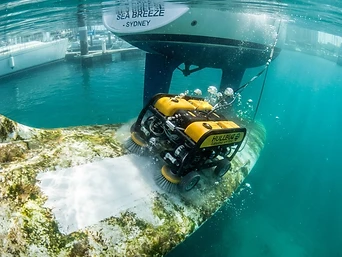
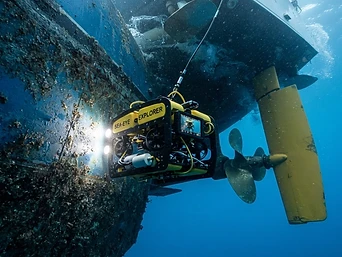
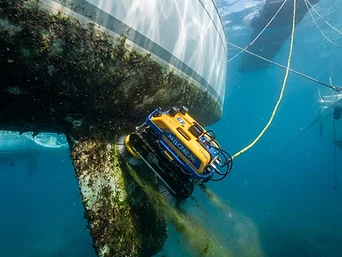
HullCare agencies operate with the Keelcrab Pro underwater robot, a professional drone designed and built in Italy for hull maintenance and inspection. Its neutral-buoyancy exoskeleton holds firmly to the hull through a suction effect generated by a marinised pump, while moving on adherence brushes that follow the geometry of the underwater hull.
Technical specifications
- Power supply
- 100/240 V AC → 28.5 V DC (low voltage)
- Power
- 370 W
- Dimensions
- 45.5 × 43 × 30 cm
- Weight
- 10 kg
- Cleaning capacity
- 7 m²/min
- Suction pump
- 35 m³/h
- Cable
- 20 m (160 kg break load)
- Warranty
- 24 months or 500 hours
A.N.C.C.P. certified brushes
The robot is fitted with interchangeable counter-rotating brushes (soft nylon, hard nylon, stainless steel) selected according to the fouling level. A.N.C.C.P. certified, they remove the first layer of growth (3 to 5 mm) without removing the antifouling — on the contrary, they extend its service life and effectiveness.
Keelcrab Bag filtration system
A variable-micrometry filter bag collects the algae and debris removed during cleaning, limiting re-attachment of growth on the hull — particularly useful in closed or stagnant waters.
How the HullCare robot works
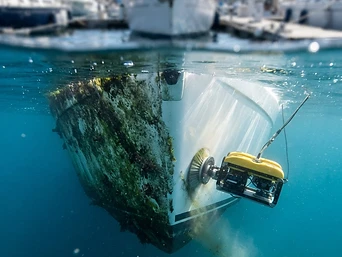
The robot moves along the submerged surface, following the hull's geometry. It removes biofilm, algae and light deposits that build up from the first weeks of immersion. The intervention is carried out afloat, in compliance with marina rules, the antifouling coating and local environmental conditions.
Why regular preventive maintenance
Biofouling builds up gradually: first a biofilm, then algae, finally heavier deposits. Intervening at a light stage is faster, more economical and better preserves the boat's performance — fuel consumption, glide and the general condition of the coating. This is the approach favoured by the HullCare Europe network.
A common standard across all agencies
Each local agency applies the same HullCare standard: intervention procedure, prior feasibility check, safety protocol, equipment usage rules, intervention sheet and client reporting. The goal is identical everywhere in Europe — regular, preventive and transparent upkeep, directly afloat.
Robotic intervention
Professional equipment on accessible hull areas.
Directly afloat
Without lifting the boat out of the water.
Before / after video
Visibility on exterior condition per service.
Prior check
Feasibility verified before each intervention.
Preventive upkeep
Limiting biofouling build-up.
Concrete intervention examples
Robotic hull cleaning and underwater inspection carried out afloat by HullCare agencies.




Book your intervention
Contact the HullCare agency in your area on WhatsApp to check feasibility and get a slot.